
Aluminum strips are used in cable armouring primarily to create a stable mechanical protective layer around the cable. This enhances the cable's resistance to crushing, impact, and external damage during transportation, installation and operation. The materials typically used for armouring purpose—5052, 5154 and 5154A aluminum alloys—belong to the Al-Mg (aluminum-magnesium) series. They offer superior strength compared to pure aluminum, along with excellent corrosion resistance and suitability for the helical wrapping process used in cable manufacturing.
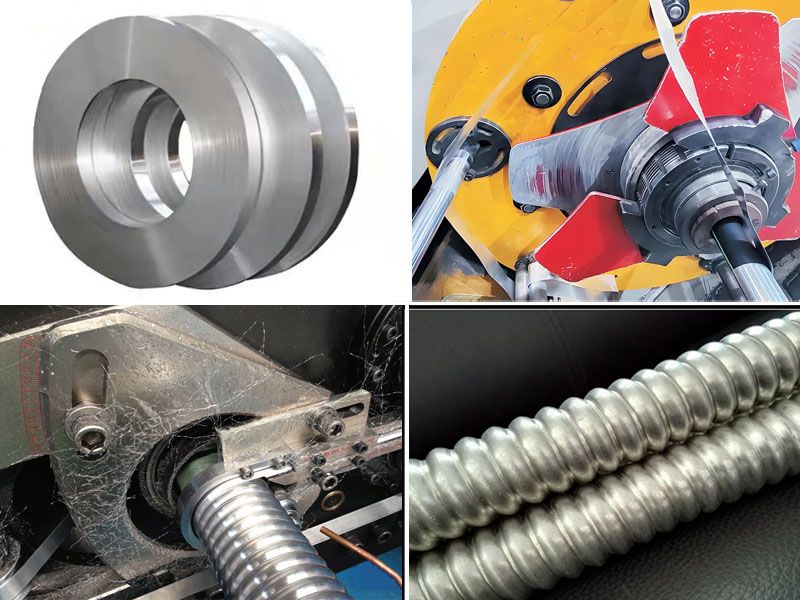
Aluminum alloy strip armoring is commonly found in single-core power cables and cable designs that require a lightweight, corrosion-resistant solution. Its suitability for a specific application should be verified during the design phase, taking into account factors such as the number of cable cores, rated voltage, short-circuit current, installation method, and local standards.
1. A Balance of Strength and Formability (Wrapping Capability)
Containing a specific proportion of magnesium, 5052, 5154 and 5154A alloys generally exhibit higher strength than 1xxx-series pure aluminum strips. During the wrapping process, the cable armouring aluminum strip must withstand tension while maintaining sufficient rigidity to form an effective protective outer layer. At the same time, it must possess adequate elongation to prevent cracking during bending, overlapping, or compression. Actual tensile strength and elongation are influenced by the material temper, thickness, and applicable product standards; therefore, the Material Test Certificate (MTC) and the technical agreement between the supplier and the purchaser should serve as the definitive references.
2. Reducing Cable Weight
With a density of approximately 2.7 g/cm³, aluminum alloy is significantly lighter than steel. Replacing some steel-tape armor components with aluminum strip effectively reduces the weight of the cable, cable reels, and installation systems, thereby facilitating long-distance transport, handling, and on-site installation.
For large-cross-section power cables, weight reduction helps lower the load during installation. However, if a project requires high tensile strength, resistance to mechanical impact, or significant load-bearing capacity, the cable designer must determine whether steel tape, steel wire, or other reinforcement structures are necessary.
3. Excellent Corrosion Resistance
Aluminum strips such as 5052, 5154 and 5154A exhibit good atmospheric corrosion resistance. In humid or typical industrial environments, they form a natural oxide film that reduces the risk of corrosion. Aluminum alloy armor is particularly advantageous for cables that require moisture and corrosion protection.
In environments involving marine salt spray, chemical agents, prolonged water exposure, or contact between dissimilar metals, attention should be paid to the risks of galvanic corrosion and crevice corrosion. Protection can be enhanced through the use of outer sheaths, separation layers, water-blocking materials, and specialized sealing designs within the cable structure.
Aluminum strips (5052, 5154, 5154A) are available in various tempers, including O, H22, H24, H26, and H32. The specific temper should be selected based on the cable-wrapping equipment, the armoring method, and the required mechanical properties. Softer tempers facilitate easier forming, while harder tempers provide greater rigidity.
Typical thicknesses range from approximately 0.20 mm to 0.50 mm. Widths—such as 20 mm, 25 mm, 30 mm, 40 mm, or 50 mm—are determined based on the cable diameter, the required overlap ratio, and the specifications of the production equipment.
Thickness tolerance, width tolerance, edge burrs, camber, strip flatness, surface cleanliness, and the number of joints in a coil can all affect the quality of high-speed wrapping processes.
When making a purchase, it is advisable to clearly define the alloy grade (5052, 5154, or 5154A), temper, thickness, width, coil inner diameter, weight per coil, and the applicable technical standard. Additionally, you should specify the intended application of the cable, the wrapping method, equipment operating speed, edge quality requirements, whether joints are permitted, and any requirements for moisture-proof packaging.
BCM Aluminum offers 5052, 5154, and 5154A aluminum alloy strips for cable armouring. We can also provide expert guidance—tailored to your specific cable manufacturing process—regarding the appropriate temper, dimensional tolerances, edge quality, and export packaging solutions.