Many people's understanding of insulation systems is limited to core materials such as insulation cotton and rock wool, neglecting the fact that the outer aluminum coil is the core barrier that blocks radiative heat transfer and maintains the long-term performance of the core material. Heat loss in an insulation system consists of three parts: heat conduction, heat convection, and heat radiation. Radiative heat transfer accounts for over 40%, a path that ordinary non-metallic outer sheaths can hardly block. Aluminum coils for thermal insulation cut off radiative heat transfer channels thanks to the high reflectivity and low emissivity of aluminum, while simultaneously blocking convection with a sealed structure and protecting the core material with a physical barrier. They are an indispensable thermal functional component in the entire insulation system.
BCM Aluminum's aluminum coils, optimized for thermal insulation scenarios, offer long-term insulation solutions for global industrial pipelines, building HVAC, and cryogenic storage tanks, with quantifiable thermal performance and stable engineering adaptability.
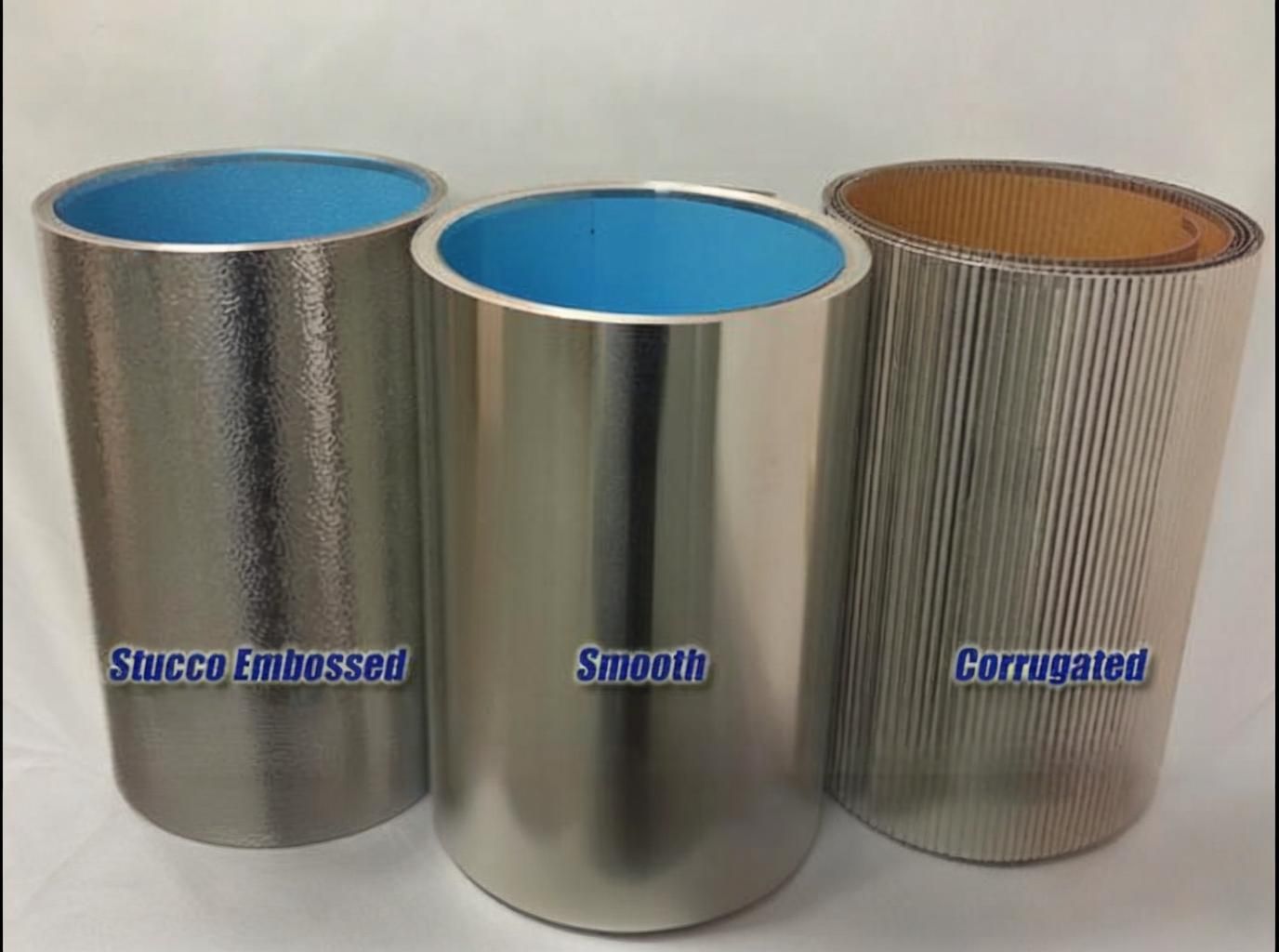
From a thermal mechanism perspective, the core insulation value of aluminum coils stems from the optical properties of their surface. Industrial pure aluminum rolled surfaces exhibit a reflectivity of ≥85% to solar thermal radiation and an infrared normal emissivity of ≤0.12, reflecting approximately 90% of ambient radiant heat and significantly reducing radiative heat transfer intensity. Combined with the conductive barrier effect of the internal insulation core material, overall heat loss is reduced by more than 30% compared to systems without a metal outer sheath. Embossed versions, such as those with orange peel or lentil shapes, can form a uniform, static air layer between the aluminum layer and the core material, further reducing solid-to-solid heat conduction and improving insulation efficiency by an additional 10%–15%. Simultaneously, the sealed aluminum jacketing completely blocks convective exchange between outside air and the core material, preventing hot and cold air carrying moisture from entering the insulation layer, structurally eliminating additional heat loss due to convective heat transfer.
BCM thermal insulation aluminum coils have different alloy choice to address corrosion and strength requirements under different operating conditions. The 1060 pure aluminum coil is a general-purpose basic model with an aluminum purity of ≥99.6% and a thermal conductivity of approximately 234 W/(m·K). It is soft and easily shaped on-site, offering excellent value and is suitable for common applications such as indoor HVAC ducts, air conditioning ducts, and building roof insulation. The 3003 aluminum-manganese alloy coil enhances corrosion resistance through manganese alloying, achieving a neutral salt spray test result of ≥500 hours. Its structural rigidity is 15% higher than pure aluminum, making it the mainstream choice for outdoor pipelines and outdoor equipment insulation. The 5005 aluminum-magnesium alloy coil combines high strength with excellent resistance to salt spray and weak acid corrosion, making it suitable for harsh conditions such as coastal chemical industrial zones and cryogenic storage tanks. Its service life is more than 40% longer than the pure aluminum coil. All series come standard with an H14 semi-rigid temper, balancing construction flexibility with finished structural rigidity. O-state soft material is available upon customization, suitable for wrapping irregular joints such as elbows, tees, and reducers.
In terms of dimensional accuracy and supporting solutions, aluminum coil for thermal insulation are manufactured in strict accordance with ASTM B209 standards, with standard thicknesses ranging from 0.2mm to 1.0mm, of which 0.3mm, 0.5mm, and 0.8mm are mainstream engineering specifications. Widths can be customized from 100mm to 1500mm, with cutting accuracy controlled within ±0.5mm, thickness tolerance stable within ±0.02mm, and board flatness ≤2mm/m. After installation, the overlaps are tight, with no warping or voids. Simultaneously, multiple vapor barrier and moisture-proof layers such as inner composite kraft paper, polyethylene film, and poly surlyn film can be added to address the risk of corrosion under the insulation layer in different humidity environments. The integrated factory composite structure can reduce on-site construction procedures by more than 20%, ensuring a continuous and uniform vapor barrier.
From petrochemical steam pipelines to cold storage tanks, from municipal HVAC systems to cleanroom ducts, the performance of thermal insulation aluminum coils spans the entire system lifecycle. It is not only a protective outer layer but also a core functional material that optimizes thermal efficiency, extends the life of the insulation core material, and reduces operation and maintenance costs. BCM Aluminum will continue to provide reliable and efficient aluminum thermal insulation solutions for various insulation projects worldwide through precise process control and a tiered product system.