
In insulation projects for industrial pipelines, storage tanks, and HVAC systems, the choice of outer protective material directly determines the heat loss rate and service life of the entire insulation system. While ordinary smooth aluminum claddings can reflect some heat, they are prone to condensation buildup when tightly bonded, and their large surface rebound and difficulty in controlling the curvature during construction further exacerbate these issues. Stucco aluminium cladding are a specialized product optimized to address these pain points—by embossing regular textured patterns onto the surface, they strengthen the air insulation layer to improve thermal performance, enhance material ductility for easier construction on curved surfaces, and improve anti-slip and anti-dentation properties. They are the mainstream choice for pipeline insulation outer protection in the petrochemical, power, and HVAC industries. BCM Aluminum offers a full range of stucco aluminium cladding coils with regular patterns and stable performance, providing cost-effective outer protection solutions for insulation projects worldwide.
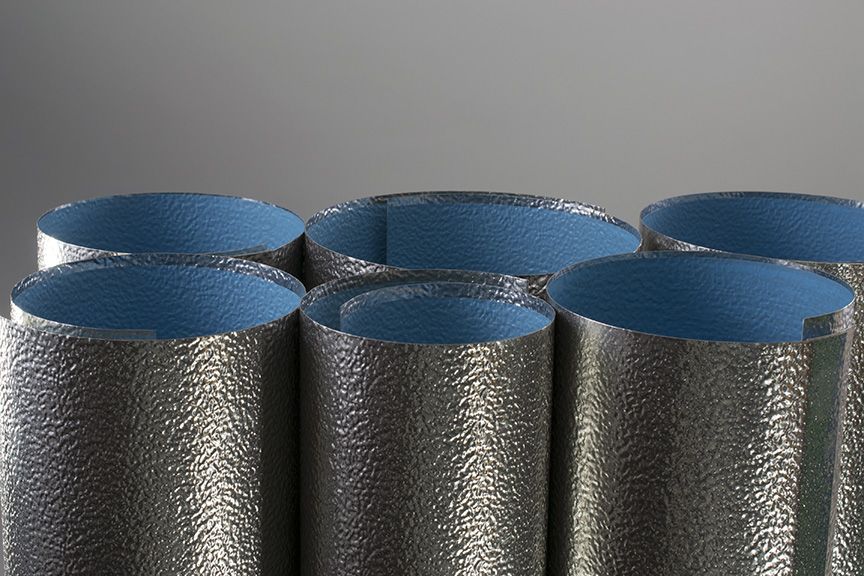
The structural design of the embossed texture is the core of its thermal performance. BCM offers three main patterns to suit different construction scenarios and performance requirements.
Orange peel texture, also known as tangerine peel pattern, is the most widely used pattern in the insulation field. Its surface features uniform, fine, raised particles that form a uniform air layer between the aluminum cladding coil and the insulation cotton, blocking the heat conduction path. Actual measurements show it can reduce additional heat loss by approximately 15%. Simultaneously, the texture disperses external impacts, improving dent resistance by more than 30% compared to a smooth surface, making it a standard choice for pipe insulation.
Diamond pattern features a regular diamond-shaped grid of raised areas, offering excellent anti-slip performance and making it suitable for scenarios requiring personnel contact, such as pedestrian access platforms and the outer walls of large storage tanks.
Bean pattern, also known as lentil pattern, features elongated oval raised areas, providing a strong three-dimensional effect and better decorative appeal. It combines anti-slip and protective functions and is commonly used for equipment shells and high-visibility insulation projects.
All three patterns are formed using precision rollers in a single pressing process, resulting in uniform texture depth, regular arrangement, and no defects such as inconsistent depth or misalignment.
The choice of substrate determines the weather resistance and construction adaptability of thermal insulation aluminum cladding. BCM stucco aluminium cladding coils primarily consist of two series: 1060 pure aluminum and 3003 rust-resistant aluminum.
The 1060 pure aluminum series has an aluminum content ≥99.6%, a stable thermal conductivity of around 230W/(m·K), and a heat reflectivity exceeding 80%. Its soft texture and good ductility make it easy to manually bend and wrap on-site, making it a cost-effective choice for conventional HVAC ducts and air conditioning ducts.
The 3003 aluminum-manganese alloy series offers significantly improved corrosion resistance, achieving over 500 hours in neutral salt spray tests. It is suitable for outdoor pipelines, chemical plant areas, and humid coastal environments, extending its service life by over 40% compared to the pure aluminum series.
The stucco aluminium cladding product is primarily in an H14 semi-rigid state, balancing structural rigidity and construction flexibility, and is less prone to deformation and collapse after wrapping.
Dimensions and precision directly affect construction efficiency. BCM stucco aluminium cladding coils are available in standard thicknesses ranging from 0.2mm to 1.0mm, with 0.3mm, 0.5mm, and 0.8mm being commonly used specifications for pipe insulation projects. Widths can be customized from 500mm to 1500mm, or prefabricated to match pipe diameters, reducing on-site cutting waste. Thickness tolerance is consistently controlled within ±0.02mm, with uniform pattern depth throughout the roll. After leveling, the flatness of the sheet surface is ≤2mm/m, ensuring smooth joints and tight overlaps during construction, effectively preventing rainwater seepage into the insulation layer. The controllable weight of each roll facilitates on-site handling and roll-based installation, improving installation efficiency.
In addition to its core insulation and protection functions, stucco aluminum cladding coils offer additional advantages such as moisture resistance, weather resistance, anti-aging properties, and a clean appearance. Furthermore, the aluminum material is fully recyclable, aligning with green engineering trends. BCM supports customized patterns, thicknesses, and widths according to project requirements, and provides pre-treatment services such as slitting, leveling, and chamfering, allowing for immediate construction upon delivery.
From municipal HVAC systems to petrochemical pipelines, from cold storage insulation to power plant pipelines, stucco aluminium cladding coils, with their dual advantages in functionality and installation, have become a reliable choice for insulation outer sheaths. BCM Aluminum will continue to provide efficient and durable aluminum protection solutions to insulation engineering customers worldwide with stable quality and flexible customization capabilities.